Installation
Install and configure Traefik Hub.
Before You Begin
It is recommended that you have a basic understanding of Kubernetes. You should have access to a working Kubernetes cluster, either on a cloud provider or on your own infrastructure.
Please make sure that you have the following:
- Kubectl
- Helm v3
- Checked the documentation about networking details to make sure that the Traefik Hub agent can communicate with Traefik Hub.
To install Traefik Hub, go to the Traefik Hub Dashboard.
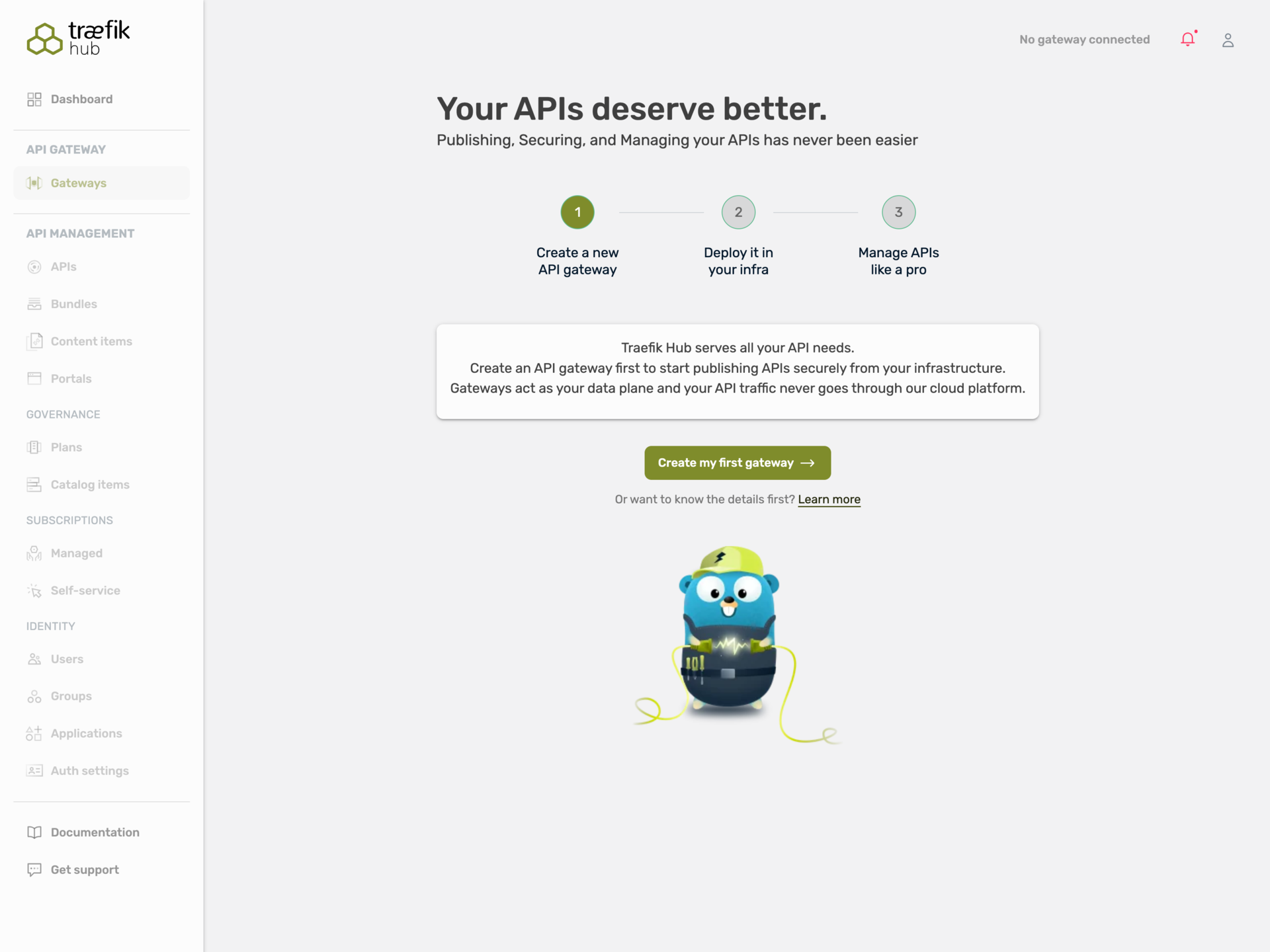
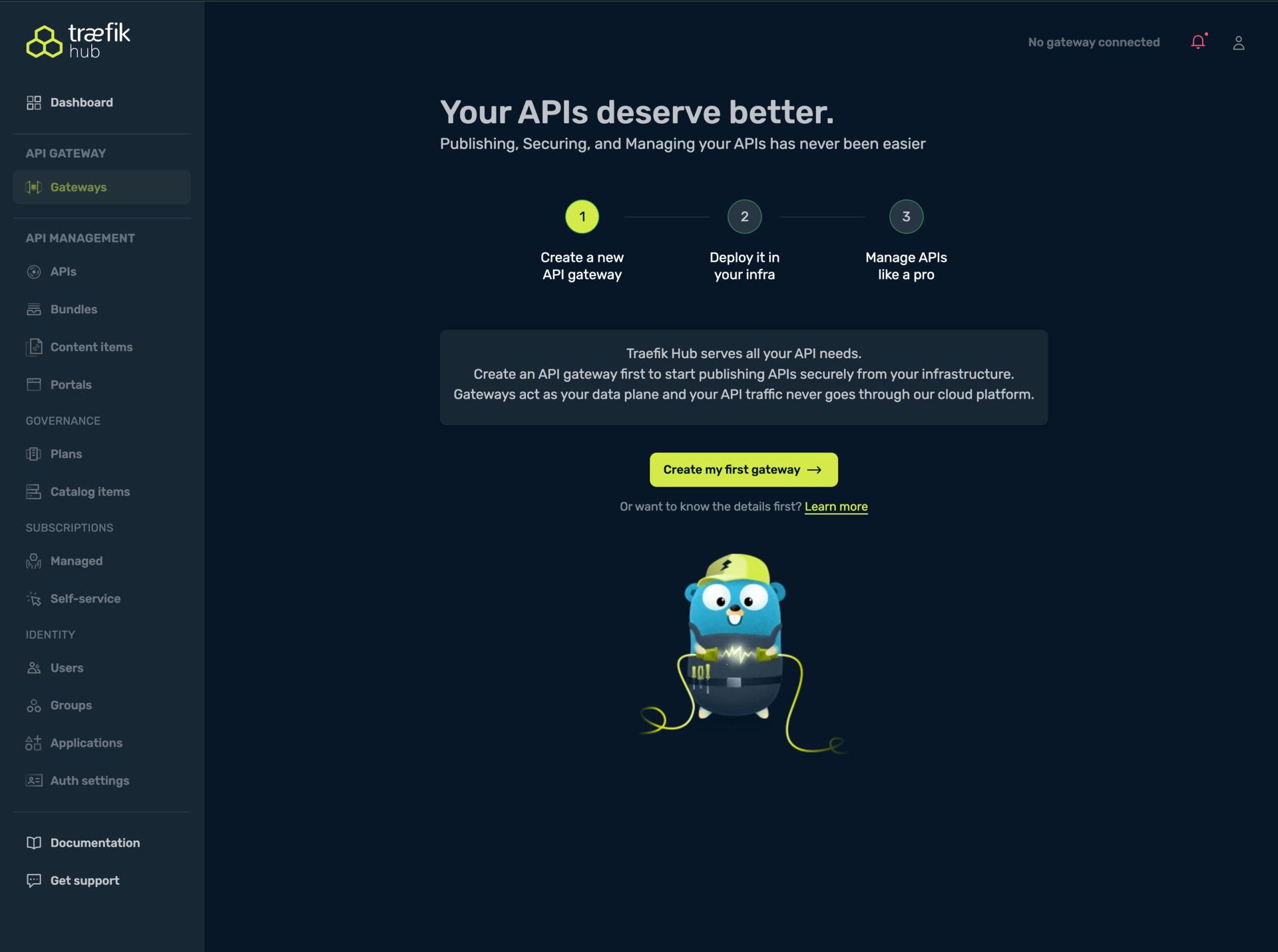
When working on a new setup, the welcome page will invite you to Create my first Traefik Hub Gateway as shown below.
This screen allows you to set the Traefik Hub Gateway name.
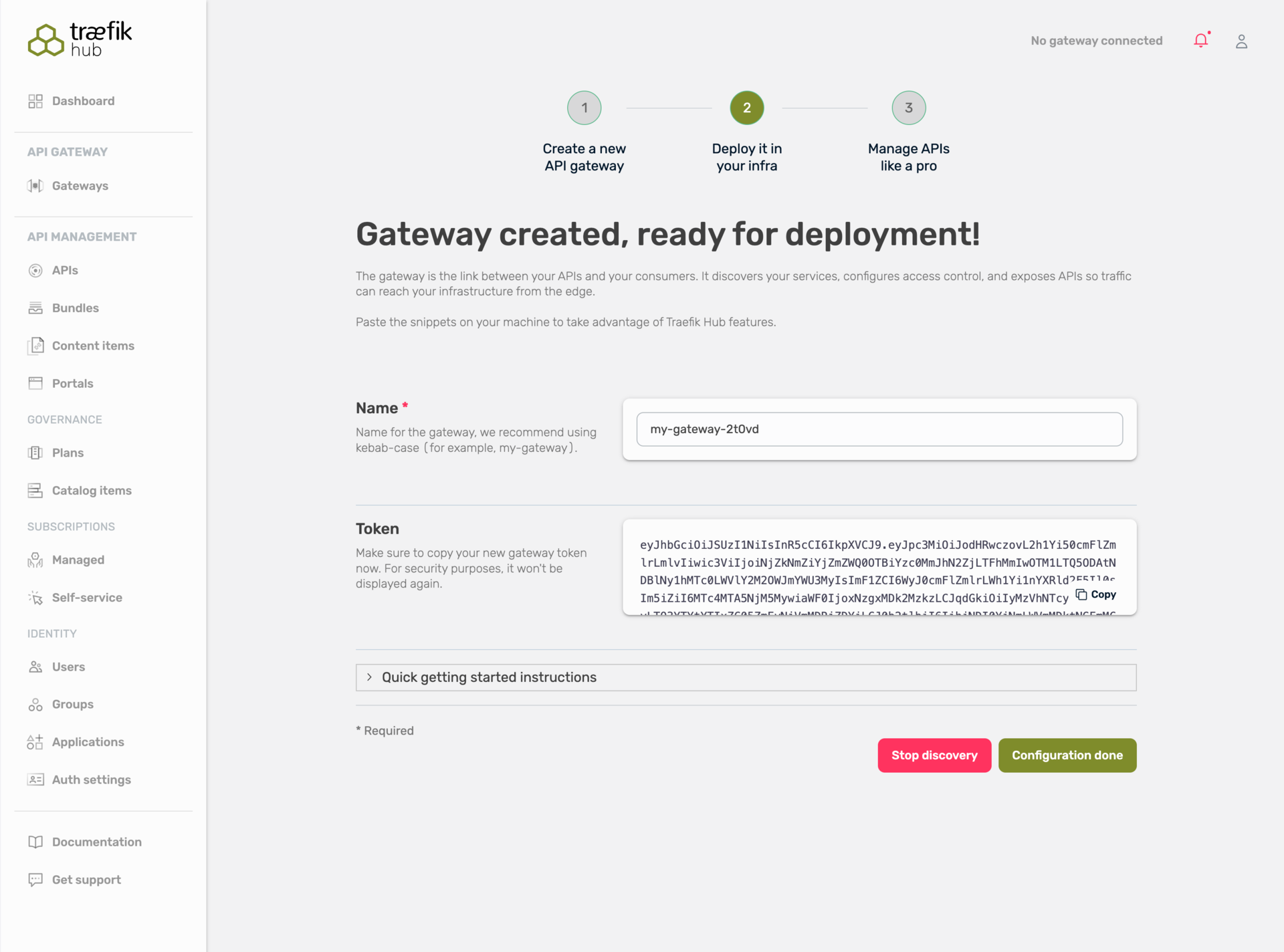
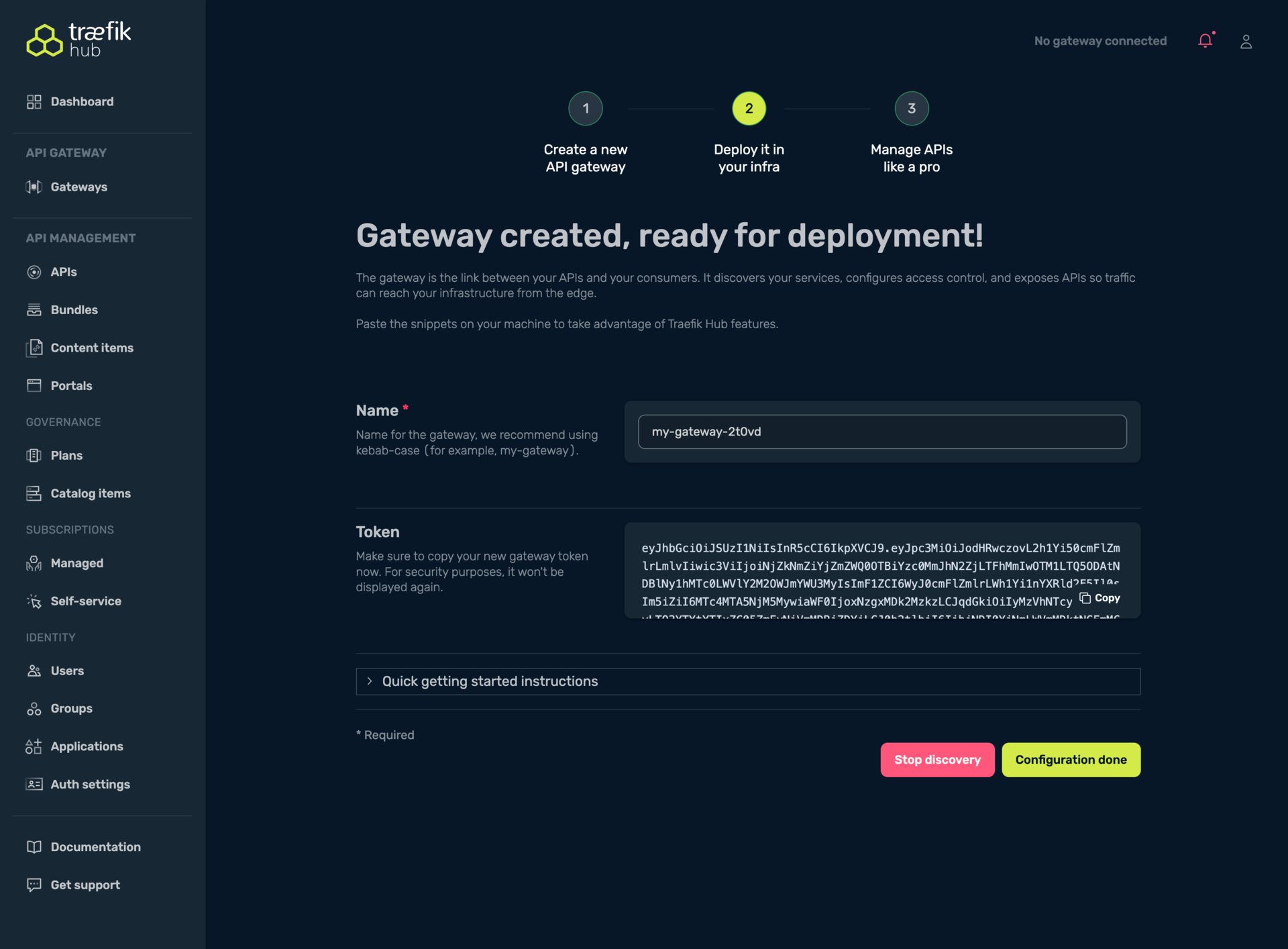
Copy and paste the instructions provided and run them on your cluster. This will install Traefik Hub Gateway.
Save the token provided for future reference. If you lose it, you can rotate the token to get a new one. See Rotating Your Token to generate a replacement.
Select Configuration Done. Traefik Hub will then detect your newly installed agent.
Token Expiration
By default, a gateway token is valid for 1 year from the date it is issued. An expired token prevents the gateway from starting. Rotate the token and roll out the new one before the expiration date to avoid disruption.
The License tokens table on the gateway's Settings page shows each token's creation date and the time remaining before it expires. To issue a new token, see Rotating Your Token.
For how a running gateway behaves when it can't reach the Traefik Hub platform, see Downtime Tolerance.
Rotating Your Token
You can rotate a token from the Traefik Hub Online Dashboard, on the gateway's Settings page, reachable from both online and offline gateway detail pages. Rotating issues a new token and schedules the existing token(s) for removal, giving you a short window to roll out the new token before the old one stops working. Rotate before the token expires. See Token Expiration. This is also how you recover access if you lose your gateway's token: rotate to issue a new one, then update your existing deployment instead of reinstalling.
- Open the gateway's License tokens settings: In the Traefik Hub Online Dashboard, open your gateway and go to Settings. The License tokens table lists each token with its creation date and the time remaining before it expires. Select Rotate.
- Confirm the rotation: Rotation cannot be undone. Existing tokens stop working and are deleted within 5 days. To confirm, type
I am surein the input field and select Confirm. - Copy the new token: The new token is shown only once. Copy it immediately and store it securely, as it cannot be retrieved later. Select Ok, got it when you are done.
- Roll out the new token: The License tokens table now lists the new token alongside the previous one, marked with the time left before it stops working.
- For offline gateways, update your gateway configuration with the new token (see Token Management in Offline Mode).
- For online gateways, update the token wherever it's configured (Helm value or
--hub.tokenflag) and restart the gateway to pick it up.
Update your gateways with the new token before the old one stops working, to avoid any interruption.
Verifying Your Token Early Access
This feature is currently in early access. Available starting v3.22.0-ea.1.
Check a token's expiration date to see how much time is left on the current token, or to confirm that a gateway uses a new token after you restart it with one. The gateway reports the date in two places:
- Startup log: at startup, the gateway logs the message
Traefik Hub license loadedwith anexpires_atfield. The message sayslicense, but the date is the expiration date of the gateway token. The message is logged at theINFOlevel. The Helm chart logs atINFOby default. If you setlog.levelyourself, or run the gateway without one (the default is thenERROR), setlog.leveltoINFOto see it. See Token Expiration Message. - Metric: the
traefik.hub.token.not_aftergauge reports the date as a Unix timestamp in seconds. The gateway publishes the gauge only through OpenTelemetry metrics, so enablemetrics.otlpto get it. See Metrics.
Before you roll out a new token, you can read its expiration date from the token itself. This reads the token you pass in, not the one the running gateway uses:
kubectl get secret license --namespace traefik -o jsonpath='{.data.token}' | base64 -d \
  | jq -rR 'split(".")[1] | gsub("-";"+") | gsub("_";"/") | @base64d | fromjson | .exp | todate'
After a rotation, compare the date with the time remaining for the new token in the License tokens table on the gateway's Settings page. If the date belongs to the previous token, the gateway still runs with that token. Check that you updated the token in the right place and restarted every replica.
To get a warning before a token expires, set an alert on traefik.hub.token.not_after in your monitoring system.
To adjust the default configuration, refer to the values files of the Chart.
Even if you can scale the number of replicas, it is not possible to deploy many different Traefik Hub Gateways on the same cluster.
The Traefik Helm Chart is open source. Contributors are welcome!
